CSS Picture Sprite is a technique of mixing a number of photos into one picture file to scale back HTTP requests and optimize internet load efficiency. There are numerous methods and useful instruments to do that, or else you may as well do it historically with Photoshop.
However, by way of all my expertise of coping with CSS Picture Sprite, there isn't a different means that a lot simpler than utilizing Sprite Operate for Compass. So, let’s check out the way it works.
Really helpful Studying: Syntactically Superior Stylesheets: Utilizing Compass In Sass
Beginning Compass
Earlier than working with Compass codes, we have to create Compass mission watch it. So, each time there's a change within the mission together with the pictures and the .scss, Compass will compile it into the right kind.
Let’s open your Terminal or Command Immediate (if you're on Home windows), and run the next instructions.
compass create /path/to/mission
cd /path/to/mission
compass watch
Combining Photographs
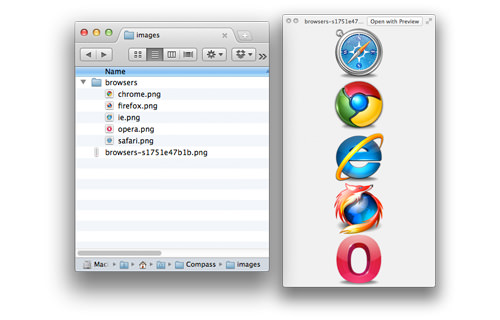
As we talked about above, you should utilize Photoshop to manually be part of the pictures or you may as well use some useful instruments, similar to SpriteBox. Compass integrates this function within the Operate. Let’s say we now have the next icons below photos/browsers/<photos>.png folders.
To hitch these icons in Compass, we will use @import rule after which direct it to the picture folders adopted by the picture extension by way of the .scss stylesheet, like so
@import "browsers/*.png";
After saving the file, Compass will mix these photos and generate new picture information, as follows.
Structure Orientation
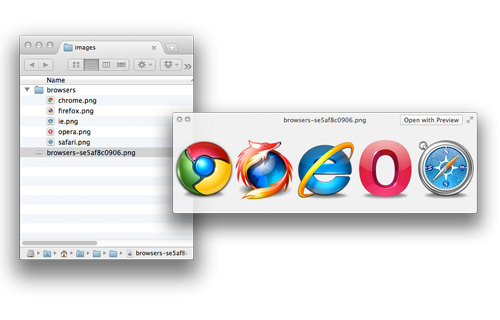
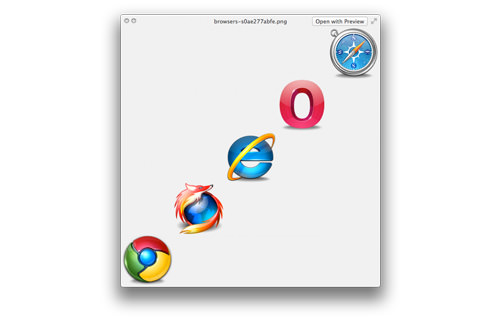
Moreover, we will additionally set the sprite orientation. As you possibly can see within the screenshot above, the pictures are organized vertically by default. In case vertical orientation doesn't match the circumstances, we will direct them horizontally or diagonally with the next variable $<map>-layout: horizontal; or $<map>-layout: horizontal; exchange the <map> with the folder identify the place you saved the pictures.
Horizontal
$browsers-layout:horizontal;
@import "browsers/*.png";
Diagonal
$browsers-layout:vertical;
@import "browsers/*.png";
Including Picture within the Stylesheet
As soon as we now have carried out combining the picture, we add the picture within the stylesheet by way of background picture. Historically we'll do it this fashion.
.chrome
.firefox
.ie
.opera
.safari
In Compass, we now have a few methods which are a lot less complicated. First, we will generate one thing like these CSS guidelines with this syntax @embody all-<map>-sprites;. Change the <map> with the folders the place we retailer the pictures.
@embody all-browsers-sprites;
This line above when compiled to common CSS generates the background picture definition in addition to every of the place, as proven under.
.browsers-sprite, .browsers-chrome, .browsers-firefox, .browsers-ie, .browsers-opera, .browsers-safari
.browsers-chrome
.browsers-firefox
.browsers-ie
.browsers-opera
.browsers-safari
Or, we will additionally add background picture individually to explicit selectors with this syntax @embody <map>-sprite(image-naem);; as in earlier codes exchange the <map> with the folder the place we retailer these photos. Right here is an instance.
li
Then, Compass is intelligent sufficient to establish the background place, with out us having to specify it explicitly. In common CSS, that line above will flip into
.browsers-sprite, li
li
Specifying Container Dimension
The very last thing we have to do is specifying the container top and width that include the picture. We generally do it in conventional means by manually inspecting the picture width and top (most certainly by way of picture information or picture properties).
With Compass, we will make the most of this perform <map>-sprite-height(image-name) or <map>-sprite-width(image-name) to retrieve the picture width and top. On this instance, we'll retrieve one of many picture width and top and retailer the worth variables as effectively assign the background picture with @embody directive.
$top: browsers-sprite-height(safari);
$width: browsers-sprite-width(safari);
li
After we compile these codes above, it turns into the next in common CSS.
.browsers-sprite, li
li
Conclusion
There are literally a number of different helpful capabilities from Compass to make use of together with, however these are all of the important capabilities to create CSS Picture Sprite with Compass. Nonetheless, if you're unfamiliar with this topic, we reccommend you to observe our earlier publish collection about Sass and Compass. We hope you discover this publish to be helpful.